(07) 3218 3900
Pay Online
Exant Advisory logo symbolising trusted, tailored financial solutions for business growth and client success in Queensland.

Property developers in ATO’s sights

Published
22 Jan 2026
Read time
2 Mins
Navigating construction challenges with Exant Advisory’s tailored solutions for sustainable business growth and client

The Australian Taxation Office (ATO) has recently issued Taxpayer Alert TA 2026/1 targeting property developers which use a development management agreement structure which is commonly used in the property development industry.

The arrangement being targeted is one where a developer has a ‘development management entity which has a contractual arrangement (development management agreement) with a landowner to develop the land.

This is commonly used with a commercial objective to provide asset protection and risk management to separate the risky development activities from the underlying land which is often purchased in a special purpose entity (trust or company).

Example of the development structure in concern

An example of the development structure (from TA 2026/1) which the ATO has outlined its concerns is below:

Diagram 1: Typical long-term construction contract arrangement – exploiting developer’s losses
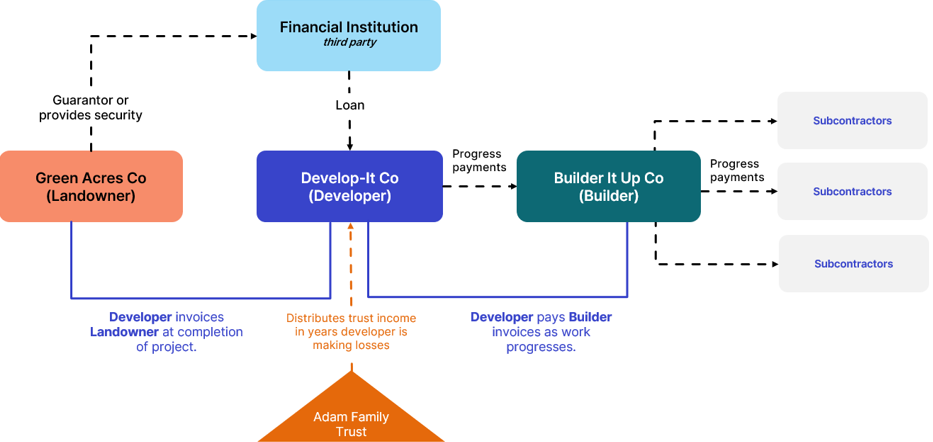
Illustration of a financial structure showing trusted relationships between a landowner, developer, builder, and financial

The ATO’s concern is with developers which control both the land and development management entity and have artificially separated the land and development management to gain a tax advantage.

Highlighted particular concern areas

The ATO highlights particular concerns where a development management entity delays invoicing the landholder to generate losses to offset against other income under the developer’s control. 

It is reviewing situations that:

  • inappropriately manipulate application of the trading stock provisions under Division 70 of the Income Tax Assessment Act 1997 by the landowner entity
  • inappropriately defer the recognition of income by the developer entity
  • generate artificial losses in the developer entity that are used to offset other income within the economic group, leading to reduced tax or no tax being paid
  • with repeated use of the arrangement in a deliberate manner, ensure reduced tax or no tax being paid, sometimes indefinitely and enable wealth extraction.

Could the general anti-avoidance provisions in Part IVA apply?

While the use of development management agreements are commercial in nature and claiming of tax deductions for development activities by the development manager are allowed under the tax law, the ATO advises these arrangements may be a scheme under which the general anti-avoidance provisions in Part IVA may apply if there is a dominant purpose of tax avoidance.

The ATO advises it will:

  • publish a Practical Compliance Guideline outlining a risk framework; and
  • engage with taxpayers undertaking these or similar arrangements

How Exant Advisory can help

Exant Advisory assists many property developers with tax advice and tax compliance. If you have any concerns with your structure, please contact your usual Exant Advisor, or one of our Partners, Nathanael Lee or Jamie Towers via the form below or on 07 3218 3900.

Author:  Jamie Towers, Tax Partner

Ready to turn insight into action?
Connect with Exant Advisory.
We respect your privacy. Your information will be used only to share updates and insights from Exant Advisory, in line with our Privacy Policy. You can unsubscribe at any time.
All rights reserved. No part of this publication may be copied, shared, or utilised in any form without the explicit prior written consent of Exant Advisory, except for brief extracts used in media, social platforms, or other communications, provided Exant Advisory and where the original source is properly credited. Exant Advisory’s intellectual property remains protected at all times, and shall not be liable for any responsibility for third-party use of this publication, regardless of whether prior authorisation was granted. Please note, this document offers a general overview and should not be relied upon as a replacement for personal advice. The information contained herein was correct at the time of publication.
Led by Experience.
Driven by New Thinking.
Get in touch with Exant Advisory today and discover how our experienced specialists and innovative solutions can help you.
Subscribe to our newsletter
Experience. New Thinking.
Straight to Your Inbox.
Subscribe to the Exant Advisory newsletter for fresh perspectives, regulatory updates, and practical strategies shaping business success in Australia and beyond.
We respect your privacy. Your information will be used only to share updates and insights from Exant Advisory, in line with our Privacy Policy. You can unsubscribe at any time.