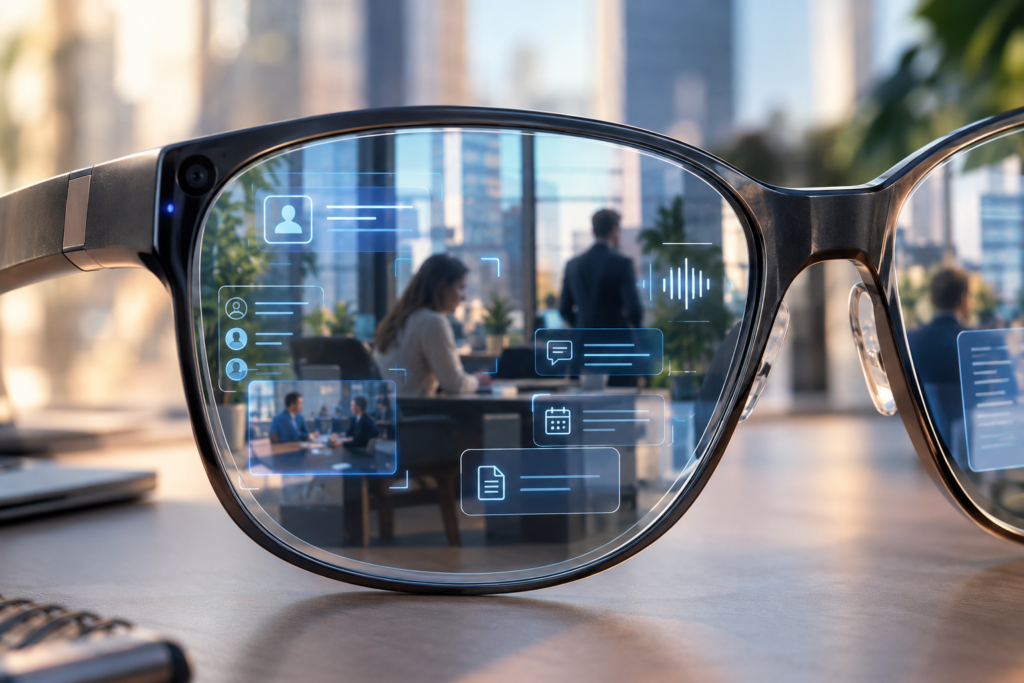
AI-enabled glasses are no longer merely a novelty and can give employees information without reaching for a phone or computer. While their potential in the workplace is significant, their ability to record discreetly raises questions about privacy, employee wellbeing and trust.
AI glasses can collect audio, images, location data and contextual information, sometimes with little or no indication to people nearby. This raises questions about consent, surveillance, confidentiality and the handling of personal or commercially sensitive information. A device worn into a client meeting or restricted site could capture material that would never ordinarily be recorded with a camera or even a mobile phone. Existing safeguards for confidential, commercial and personal information may no longer be sufficient.
Every workplace should assess the information and data risks associated with AI-enabled glasses. The nature and severity of those risks will depend on the information employees can access.
Employees may feel distressed or apprehensive at the prospect of being recorded without their knowledge or consent, particularly during discussions about personal matters, performance or conduct. Subsequently discovering that a recording was made can deepen that distress and damage trust.
The real possibility of undisclosed recording is a psychosocial risk that needs to be managed. Employers should consider their workplace health and safety obligations, applicable surveillance laws and existing codes of conduct when setting expectations for the use of AI-enabled glasses in the workplace.
AI enabled glasses are now more affordable and accessible therefore, employers should assess the risks and establish clear boundaries for their use now. Waiting for the law to catch up risks undermining employee trust, wellbeing and accountability as well as potential commercial risks in relation to information and data security.
Codes of Conduct generally contain a provision about demonstrating respect, however these provisions may not make it sufficiently clear that recording without the knowledge and consent of the person or persons being recorded, is unacceptable as it fails to demonstrate respect. We recommend explicit guidance on all recording devices, including AI enabled glasses. The wording will depend on each workplace code of conduct, but the following example may assist:
Employees must always treat colleagues, clients and others who enter the workplace with respect. This includes not using any recording device, including wearable technology such as AI enabled glasses, to record a colleague, client or other person in the workplace without that person’s explicit knowledge and consent.
AI enabled glasses and other wearable technology must not be worn in areas where there is a reasonable expectation of privacy, such as bathrooms or changing rooms. An exception may apply where a person requires the technology as a disability-related aid. In that case, the device may be worn but must not be used to record images or audio in those areas.
Keeping pace with technology is an ongoing challenge for most workplaces, but it should not prevent employers from protecting the psychosocial wellbeing of their workforce and others who enter the workplace or the commercial interests of their business.
If you need assistance updating an existing code of conduct or introducing a new one, please contact your usual Exant advisor, or alternatively our HR & IR experts via the form below or on 07 3218 3900.