

(07) 3218 3900
Pay Online
Exant Advisory logo symbolising trusted, tailored financial solutions for business growth and client success in Queensland.
Brisbane cityscape at sunrise, symbolising Exant Advisory’s commitment to innovative and tailored business growth solutions.

2026/27 Federal Budget Highlights

Tax and Superannuation Brief
By Exant Advisory
Coastal waves symbolising Exant Advisory's tailored solutions fostering business growth and success in Queensland.
The Federal Treasurer, Dr Jim Chalmers, handed down the 2026–27 Federal Budget at 7:30pm (AEST) on 12 May 2026.

Claiming to be a budget of resilience and reform, the Government advises it is helping Australians now and building Australia's future by:

  • Responding to the global oil shock
  • Taking pressure off Australians
  • Making our economy more productive
  • Delivering tax reform for workers, businesses and future generations; and
  • Building a stronger and more sustainable budget

In particular, the Federal Budget Tax Brief highlights the Government’s proposed tax reform package which contains 3 key parts and claims it creates:

  • a “better” tax system for workers, first home buyers and future generations
  • a “better” tax system for businesses by encouraging investment and innovation, and
  • a “simpler and more sustainable” tax system.

While the 2026-27 Federal Budget focused on broad tax and investment reforms, superannuation remained largely on the sidelines.

The full Budget papers are available at www.budget.gov.au and the Treasury ministers’ media releases are available at ministers.treasury.gov.au.

Exant Advisory's tax and superannuation highlights are set out below.

Seamlessly build your business success with Exant Advisory’s expert, client-focused financial strategies in Queensland.

Income tax

CGT discount to be replaced with cost base indexation for all CGT assets from July 2027

From 1 July 2027, the 50% capital gains discount (CGT discount) will be replaced with cost base indexation for assets held for more than 12 months, with a 30% minimum tax on net capital gains applying from that date. This will apply to all CGT assets except new homes, including pre-CGT assets, held by individuals, trusts and partnerships.

Cost base indexation
Cost base indexation, which was replaced in September 1999 with the CGT discount, works by adjusting the cost base of the relevant CGT asset. Please refer to our earlier article on how indexation works: What is Capital Gains Indexation and why does it matter?

The measure essentially restores the taxation of CGT assets by applying inflation-adjusted indexation based on the Consumer Price Index (CPI) to tax real gains. Indexation will be calculated using CPI similar to the pre-September 1999 method. The ATO will provide guidance and tools to support taxpayers calculating this adjustment.

Importantly, a minimum tax of 30% will be applicable to realised capital gains accrued from 1 July 2027, after indexation has been applied.

Existing investments
Transitional arrangements will apply to existing investments. Existing assets purchased and sold before 1 July 2027 will still be eligible for the CGT discount. The CGT discount will also continue to apply to gains accrued until 1 July 2027 for assets purchased prior to that date, regardless of when the actual CGT event is triggered. The difference will be calculated by reference to the difference in the asset’s cost base and its value as at 1 July 2027. Indexation and the minimum 30% tax will be used to calculate CGT on gains accruing from 1 July 2027 (using the asset’s value at 1 July 2027 as the asset’s cost base).

Determining an asset's value
An asset’s value at 1 July 2027 will be determined by taxpayers as part of their tax return in the year the asset is realised. Taxpayers can either:

  • seek a valuation of the asset as at 1 July 2027, which will include using quoted prices for assets such as shares, or
  • use a specified apportionment formula that estimates the asset’s value on 1 July 2027, based on its growth rate over the asset’s holding period. The ATO will provide tools to estimate this value for taxpayers.

These transitional arrangements also apply to legacy assets, including pre-CGT assets. Capital gains arising on pre-CGT assets before 1 July 2027 will remain exempt from CGT.

Owners of new builds
Owners of new builds will be able to choose either the CGT discount or cost base indexation (with the 30% minimum tax still applicable). New builds include dwellings constructed on vacant land, or where existing properties are demolished and replaced with a greater number of dwellings. Knock down rebuilds or substantial renovations are not considered new builds and therefore will not be eligible. A new build cannot have been previously sold, unless first owned by the builder and not occupied for more than 12 months.

Exemptions
Income support payment recipients (including Age Pension and JobSeeker payment recipients) will be exempt from the 30% minimum tax if they receive payment in the financial year in which they realise the capital gain.

Discretionary trusts to be taxed at minimum 30%

A minimum tax rate of 30% is proposed to be introduced on discretionary trusts from 1 July 2028.

The current Australian taxation laws
Currently, under Australian taxation laws, discretionary trusts are not considered separate taxable entities. Broadly, it is the beneficiaries of discretionary trusts who are ultimately entitled to receive and retain trust income and are taxed on the net income of the trust (as defined for income tax purposes). The trustee is then, generally, taxed on the balance (if any) of the net income (subject to certain exceptions) that is not distributed. Trustees are also taxed if no beneficiaries are made presently entitled to trust income.

Proposed new measure
Under the new measure, trustees will pay a minimum tax of 30% (unless higher rates apply) on the taxable income of discretionary trusts from 1 July 2028. Beneficiaries (other than corporate beneficiaries) will receive non-refundable credits for any tax payable by the trustee.

Trustees will be required to calculate, report and pay the minimum tax, as well as to notify beneficiaries of their entitlements and associated tax credits. The mechanism for collecting the minimum tax will be subject to consultation, but is expected to be consistent with established collection mechanisms. Trustees that receive franked dividends will be required to use their franking credits to pay the minimum tax.

The minimum tax will not be applicable to:

  • other types of trusts (eg unit trusts or widely-held trusts)
  • complying superannuation funds
  • special disability trusts
  • deceased estates, and
  • charitable trusts.
The press release advises that corporate beneficiaries will be assessed on the trust income to which they are entitled without being able to claim a credit for the tax paid by the trustee. While this is intended to ensure that the minimum 30% trust tax rate cannot be avoided by distributing to a ‘bucket company’ and creating franking credits which could ultimately be refunded, it is unclear whether this will lead to double taxation.

Importantly, income from assets of discretionary testamentary trusts existing as at 7:30pm (AEST) on 12 May 2026 will be excluded from the minimum tax. Some other types of income such as primary production income, certain income relating to vulnerable minors and amounts to which non-resident withholding tax applies, will also be excluded.

Expanded rollover relief provisions will be available for 3 years from 1 July 2027 to support taxpayers that wish to restructure out of discretionary trusts to another entity type (such as a company or fixed trust).
Seamlessly build your business success with Exant Advisory’s expert, client-focused financial strategies in Queensland.

Individuals

Negative gearing restricted to new builds from July 2027

Negative gearing for residential property will be limited to new builds from 1 July 2027.

Broadly, where net losses arise as a result of deductible expenses associated with income-producing property exceeding the income earned from that property, negative gearing allows for this resulting net loss to be offset against other assessable income of the taxpayer.

Proposed new measures
Under the new measures, negative gearing will be limited to eligible new builds only. This means that investors in new builds will still be able to deduct rental losses against other assessable income, such as their salary. New builds include dwellings constructed on vacant land, or where existing properties are demolished and replaced with a greater number of dwellings.

Knock-down rebuilds or substantial renovations are not considered new builds and therefore will not be eligible for negative gearing.

A new build cannot have been previously sold, unless first owned by the builder and not occupied for more than 12 months.

Proposed application of measures
The measure will apply to individuals, partnerships and most trusts.  Widely-held trusts (eg most managed investment trusts) and superannuation funds (including self-managed superannuation funds) will be excluded.

Losses incurred from established residential properties will only be deductible against rental income or capital gains arising from residential properties. Any excess losses will be able to be carried forward and offset against income from residential property in future years.

These changes will apply to any established residential properties acquired from 7:30pm (AEST) on 12 May 2026. Any residential properties acquired prior to this time (including any contracts entered into but not settled) will be grandfathered, and will therefore be exempt from the changes until disposed of.  Residential properties acquired between 7:30pm (AEST) on 12 May 2026 and 30 June 2027 may be negatively geared during this period, but not from 1 July 2027.

Exclusions
Properties held in widely-held trusts and superannuation funds will be excluded from these measures, with exemptions for build-to-rent developments and private investors supporting government housing programs.

Changes to negative gearing only apply to residential properties. Commercial property and other asset classes, such as shares, will remain eligible for negative gearing. Exemptions to negative gearing will also be available for private investors who support government housing programs (through the provision of affordable housing).
Amendments to clarify the arrangements for managed investment trusts (MITs) will be made to ensure legitimate investors can continue to access concessional withholding tax rates for fund payments from 13 March 2025.
In particular, trusts ultimately owned by a single widely-held investor will be able to access the MIT concessions. The proposed changes will ensure that genuine, foreign-based widely-held investors, such as pension funds, can still access concessional withholding tax rates on eligible distributions to members through MITs.

New working Australians tax offset from 2027–28

Each working Australian taxpayer will receive a $250 Working Australians Tax Offset from the 2027–28 income tax year.

From 1 July 2027, the Working Australians Tax Offset (WATO) will provide a permanent annual tax offset for Australians for their income derived from work, such as wages and salaries and the business income of sole traders. It will increase the effective tax-free threshold for income derived from work by nearly $1,800 to $19,985 (or up to $24,985 for workers eligible for the low income tax offset (LITO)). It will be paid automatically via workers’ tax returns at the end of the year.

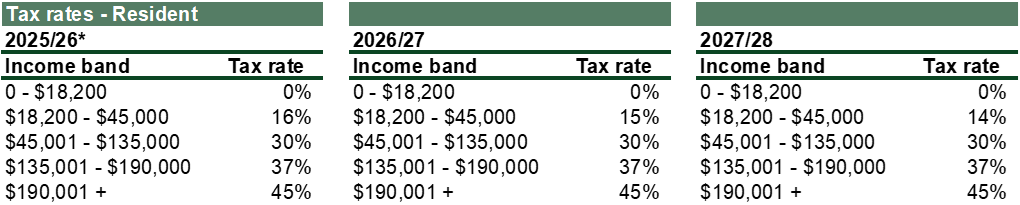
The offset is in addition to the proposed $1,000 instant tax deduction for resident individuals who earn income for work from 1 July 2026 and the legislated 2025–26 Budget measure to reduce the personal income tax rates for individuals from 1 July 2026 and 1 July 2027.
Future tax rate table simplifying complex financial decisions; Exant Advisory fosters client growth through trusted, tailored advice.

Medicare levy low-income thresholds to be increased

The Medicare levy low‑income thresholds for singles, families, and seniors and pensioners will be increased by 2.9% from 1 July 2025.

The threshold for singles will be increased from $27,222 to $28,011.
The family threshold will be increased from $45,907 to $47,238.
For single seniors and pensioners, the threshold will be increased from $43,020 to $44,268.
The family threshold for seniors and pensioners will be increased from $59,886 to $61,623.
The family income thresholds will increase by $4,338 for each dependent child or student, up from $4,216.

Restrictions on foreign ownership of housing and strengthening the foreign investment framework

The temporary ban on foreign purchases of established residential dwellings will be extended by 2 years and 3 months until 30 June 2029. The ban, which was announced as a measure in the 2025–26 Budget, was originally implemented for 2 years from 1 April 2025.

Current limited exceptions to the ban for purchases of established dwellings that support housing supply will continue. General exemptions from foreign investment screening will also continue to apply for purchases of established dwellings, including for permanent residents and New Zealand citizens.

Seamlessly build your business success with Exant Advisory’s expert, client-focused financial strategies in Queensland.

Business

Transitioning to a permanent 25% FBT discount for certain electric vehicles

Currently, all electric vehicles that are not a plug-in hybrid are exempt from FBT.
To ensure the system remains sustainable, Australia will transition to a permanent 25% discount on FBT for certain electric vehicles (EVs).

From 1 April 2029, a permanent 25% discount on FBT will be available for all electric cars valued up to and including the fuel‑efficient luxury car tax (LCT) threshold, implemented through a 15% rate in the FBT statutory formula.

The following transitional arrangements will be adopted:

  • all eligible electric cars will retain the FBT discount rate that was in place when the arrangement commenced
  • all electric cars valued up to and including $75,000 that are provided before 1 April 2029 will continue to be eligible for a 100% discount on FBT, implemented through a 0% rate in the FBT statutory formula, and
  • electric cars valued above $75,000 and up to and including the fuel‑efficient LCT threshold that are provided between 1 April 2027 and 1 April 2029 will be eligible for a 25% discount on FBT, implemented through a 15% rate in the FBT statutory formula.

The existing 20% statutory rate will continue to apply for all other cars, including electric cars costing more than the fuel‑efficient LCT threshold.

Reportable fringe benefits will continue to be determined for eligible electric cars as if a 20% FBT statutory formula rate or cost basis method applied.

Small business depreciation — instant asset write-off of $20,000 made permanent

The instant asset write-off threshold of $20,000 for small businesses applying the simplified depreciation rules has been extended permanently from 1 July 2026.

Small businesses (aggregated annual turnover less than $10 million) may choose to calculate capital allowances for depreciating assets under a simplified regime in Subdiv 328-D of ITAA 1997. Under these simplified depreciation rules, an immediate write-off applies for low-cost depreciating assets. A $20,000 threshold currently applies for the immediate write-off, applicable to eligible assets costing less than $20,000.

Assets valued at $20,000 or more (which cannot be immediately deducted) can continue to be placed into the small business simplified depreciation pool and depreciated at 15% in the first income year and 30% each income year thereafter. The provisions that prevent small businesses from re-entering the simplified depreciation regime for 5 years if they opt out will be suspended until 30 June 2027.

Permanent 2-year loss carry back rules introduced

From 1 July 2026 companies with aggregated annual global turnover of less than $1 billion will be able to use their current year tax losses to claim a refund for taxes paid in the prior 2 income years.

The loss carry back tax offset, contained in Div 160 of ITAA 1997, was a temporary measure which applied from the 2019−20 to 2022−23 income years. Broadly, it allowed certain eligible companies to choose to carry back income tax losses incurred in those specific income years and apply them against their taxed profits in a previous income year. The benefit generated by this loss carry back was received in the form of a refundable tax offset (called the loss carry back tax offset). The offset effectively represented the tax that the company would have saved if it had been able to deduct that loss in the earlier year using the loss year tax rate.

The measure essentially re-introduces the loss carry back offset permanently for eligible companies and allows them to carry back tax losses and offset them against taxes paid up to 2 years earlier. The previous measure had been available to companies with an aggregated turnover of less than $5 billion.

As with the previous temporary measure, the loss carry back tax offset will apply to revenue losses only and will be limited to the company’s franking account balance.

Importantly, the offset will be limited to the value of fringe benefits tax and withholding tax on wages paid in respect of Australian employees in the loss year.

Loss refundability introduced for small start-ups

Small start-up companies that generate a tax loss in their first 2 years of operation will be able to utilise that loss to generate a refundable tax offset. The measure will apply for tax years commencing on or after 1 July 2028 to start-up companies with aggregated annual turnover of less than $10 million.

Importantly, the offset will be limited to the value of fringe benefits tax and withholding tax on wages paid in respect of Australian employees in the loss year.

Reforms to R&D tax incentive announced

The Research and Development (R&D) Tax Incentive will be reformed to make it easier to use, increasing the incentive for new businesses to invest in R&D activities.

From 1 July 2028, the measure proposes to:

  • increase the offset for experimental “core” R&D expenditure from 25% to 50% through a 4.5 percentage point increase in core R&D offset rates
  • remove the eligibility of supporting R&D expenditure for the R&D tax incentive
  • reduce the intensity threshold from 2% to 1.5%, enabling more firms to qualify for higher offset rates
  • allow greater access to the highest refundable tax offset for businesses younger than 10 years by increasing the turnover threshold from $20 million to $50 million, with an equivalent non-refundable offset available for eligible businesses older than 10 years
  • lift the maximum R&D tax incentive expenditure threshold from $150 million to $200 million, and
  • lift the minimum expenditure threshold from $20,000 to $50,000, with smaller R&D projects valued below $50,000 required to be undertaken with a recognised research organisation to support quality research outcomes.
The ATO will be responsible for implementing and administering this measure.

The measure forms part of the first stage of the government’s response to the Ambitious Australia: Strategic Examination of Research and Development Final Report (Report). The Report, which was released on 17 March 2026 by an independent panel and commissioned by the government as part of the 2024–25 Budget, provides 20 recommendations to reform Australia’s R&D system and strengthen national capability.

Venture capital tax incentives to be expanded

The venture capital limited partnership (VCLP) and early stage venture capital limited partnership (ESVCLP) tax incentives will be expanded from 1 July 2027. The eligible venture capital investor program will be closed to new applications from 12 May 2026 7:30pm (AEST).

From 1 July 2027:

  • the VCLP cap on the asset size of the investee business at the time of investment will be increased from $250 million to $480 million
  • the ESVCLP cap on the asset size of the investee business at the time of investment will be increased from $50 million to $80 million
  • the ESVCLP tax incentive cap on the asset size of the investee business, at which investment returns can be fully tax exempt, will be increased from $250 million to $420 million, and
  • the maximum fund size of ESVCLPs will be increased from $200 million to $270 million.
The increases will apply to new and existing funds and to new investments they make, including where funds make further investments in businesses already held. ESVCLPs must remain in compliance with their existing investment plans or seek approval for a replacement plan.

This measure forms part of the first stage of the government’s response to the Ambitious Australia: Strategic Examination of Research and Development Final Report.

OECD Pillar 2 side-by-side package to be implemented

The global and domestic minimum tax legislation will be amended from 1 January 2026 to implement the side-by-side package agreed by the OECD/G20 Inclusive Framework on Base Erosion and Profit Shifting on 5 January 2026.

The global and domestic minimum tax law was implemented in Australia by the Taxation (Multinational — Global and Domestic Minimum Tax) Act 2024, in line with Pillar Two of the Two-Pillar Solution of the OECD/G20 Inclusive Framework on Base Erosion and Profit Shifting (BEPS) (the Inclusive Framework) to address tax challenges arising from the digitalisation of the economy.

The Inclusive Framework agreed to a side-by-side package on 5 January 2026 that included the following 5 key components: 

  • a series of simplification measures to reduce compliance burdens for multinational enterprises (MNEs) and tax authorities in calculating and reporting under the global minimum tax rules
  • introduction of a new targeted substance-based tax incentive safe harbour to align the treatment of tax incentives globally
  • new safe harbours for MNE groups having an ultimate parent entity located in an eligible jurisdiction that meets minimum taxation requirements
  • an evidence-based stocktake process to ensure a level playing field is maintained for all Inclusive Framework members, and
  • reinforcement of the objective that qualified domestic minimum top-up tax regimes remain a primary mechanism in the global minimum tax framework for ensuring the protection of local tax bases, particularly in developing countries.

Australian legislation will be amended to implement the side-by-side package from 1 January 2026 to ensure Australia’s global minimum tax rules are consistent with those of other implementing jurisdictions.

Seamlessly build your business success with Exant Advisory’s expert, client-focused financial strategies in Queensland.

Tax administration

Access to monthly business tax payments and dynamic calculations for small and medium businesses

Small and medium businesses will be able to choose to report and make business tax payments monthly from 1 July 2027. These businesses will also be able to use an ATO-approved calculation embedded in accounting software to dynamically calculate and vary their PAYG instalments on a monthly basis.

Interest charges levied on businesses that accidentally get their instalment variation incorrect when using ATO-approved calculators will be removed by the ATO.

Monthly reporting and payment of PAYG instalments will be mandatory for taxpayers with a demonstrated history of non-compliance.

The ATO will be provided funding by the government to allow for expansion of the dynamic instalment calculation pilot.

Protecting and strengthening the tax system against fraud

The government will provide funding of $86.3 million over 4 years from 1 July 2026 and $9.7 million per year ongoing from 2030–31 to deliver Phase 2 of the Counter Fraud Strategy to modernise the prevention and detection of fraud in the tax and superannuation systems.

The proposal will enhance the ATO’s ability to detect and prevent fraud in real time, provide additional fraud protections for individuals and expand live monitoring of fraudulent account access to tax agents, business and for high‑risk superannuation changes.

The ATO’s ability to combat fraud by tax agents and other intermediaries will also be strengthened. The ATO will be given powers to pause the recovery of tax debts of taxpayers who are victims of fraud by tax intermediaries, and waive those debts in appropriate circumstances, and to recover the debts from the tax intermediaries. Existing garnishee powers will also be expanded to include jointly held assets in circumstances where such arrangements are being used to frustrate recovery actions.

Further targeted exceptions to tax secrecy and enhancements to tax regulators’ information‑gathering powers to support integrity, compliance and effective administration of the tax system will also be progressed.

The ATO will also undertake additional targeted compliance activities over the 2 years from 2026–27 to further address fraud in the system, including in relation to the R&D Tax Incentive.

Governance of managed investment schemes to be strengthened

Funding will be provided from 2026–27 to strengthen governance requirements, supervision and enforcement in relation to managed investment schemes.

In particular:

  • $10.3 million will be provided in 2026–27 for ASIC to enhance its ability to utilise data in its supervision of the managed investment scheme (MIS) sector
  • $7.6 million will be provided over 4 years from 2026–27 (and $1.4 million per year ongoing) for ASIC, the Office of the Australian Auditing and Assurance Standards Board and the Treasury to strengthen governance requirements for MISs.

The government will also consult publicly on new data collection powers in relation to MISs.

Streamlining regulatory systems

Funding will be provided over 2 years from 2026–27 to streamline regulatory systems and secure access to data. Legislation will also be introduced to improve regulation in the financial sector.

Funding initiatives will be provided to streamline regulator systems and secure access to data. These include:

  • $136.1 million over 2 years from 2026–27 to complete the second tranche of stabilisation and uplift of Australia’s business registers, including synchronising director information with the Australian Charities and Not‑for Profits Commission’s Charities Register, linking Director IDs to the Companies Register, uplifting Australian Business Number (ABN) authentication and completing the transition of ABN and superannuation lookup functions to the ATO
  • $62.0 million over 2 years from 2026–27 to extend the operation and participation in the Consumer Data Right to continue supporting Australian consumers and businesses and to explore the potential to enable taxpayers to share certain ATO‑held data through the Consumer Data Right.
Legislation will also be introduced to modernise, simplify and improve regulation in the financial sector to reduce unnecessary reporting and disclosure requirements and simplify financial system frameworks.

For superannuation, ASIC instruments will be legislated to address unnecessary disclosure requirements and to align portfolio holdings disclosure obligations for internally managed private debt with externally managed private debt.

The government’s modernising business communications agenda will be strengthened. This includes updating laws that may prevent businesses from keeping records electronically, allowing ASIC to update forms to streamline communication with businesses and individuals, and allowing the Australian Small Business and Family Enterprise Ombudsman to better use technology to communicate with the public. This will give businesses greater flexibility in meeting their record-keeping obligations under the superannuation and corporations laws.

In addition, administrative burden from the financial accountability regime will be reduced. Routine and low-value notifications by regulated entities will be reduced by not requiring reporting of accountability statements and maps, removing the need to report low-value breaches, providing more time to register accountable persons, and aligning terminology and timing.

Importantly for many Exant Advisory clients, the criteria for a Large Proprietary Limited company will be increased to $100 million of gross revenue (from $50 million) and $50 million of gross assets (from $25 million). Companies below the relevant criteria will no longer be required to lodge audited financial statements with ASIC.

Options to harmonise payroll tax administration

Reforms to harmonise state payroll tax administration frameworks will be explored as part of the government’s national competition policy (NCP), in its efforts to boost productivity and reduce red tape.
Seamlessly build your business success with Exant Advisory’s expert, client-focused financial strategies in Queensland.

Superannuation

While the 2026-27 Federal Budget focused on broad tax and investment reforms, superannuation remained largely on the sidelines.

Below is a summary of the key superannuation-related measures.

Higher tax on very large superannuation balances

The Government confirmed it is proceeding with the previously legislated changes to reduce tax concessions on superannuation balances exceeding $3 million. While these take effect from 1 July 2026, impacts are not felt until after 30 June 2027 and planning opportunities remain.

Payday Super confirmed from 1 July 2026

From 1 July 2026, employers will be required to pay superannuation contributions at the same time as wages, rather than on a quarterly basis.

This reform is designed to:
• Improve retirement outcomes through earlier and more frequent compounding
• Reduce the risk of unpaid or delayed superannuation
• Increase transparency through real time payroll reporting

For employees, this is expected to improve long term superannuation balances. Employers will need to ensure payroll systems and processes are updated ahead of implementation.

Superannuation Guarantee final increase to 12% complete

As previously legislated, the Superannuation Guarantee (SG) has already risen to 12% from 1 July 2025, completing the final step of the legislated increase.

This applies to all eligible employees increasing compulsory employer contributions for all eligible employees.

Superannuation not impacted by key tax changes

The capital gains tax (CGT) and negative gearing reforms announced in the Budget do not apply to superannuation. Superannuation continues to operate under its existing concessional tax framework.

The CGT changes target assets held by individuals, trusts and partnerships outside superannuation. Superannuation funds (including SMSFs) retain their current tax treatment, including concessional CGT rates in accumulation and exemption in pension phase.

Likewise, the negative gearing changes are directed at personally held residential property, with superannuation funds excluded from these measures.

As a result, superannuation remains one of the most tax effective environments for long term investment despite broader tax reforms.
Coastal waves symbolising Exant Advisory's tailored solutions fostering business growth and success in Queensland.
If you have any questions, please speak to your usual Exant adviser or contact our Tax Partner, Jamie Towers, and Superannuation Partner, Clive Todd, on 07 3218 3900 or by completing the form below.
Exant Advisory’s views on the Government’s 2026 / 2027 Federal Budget are based on our review of the Federal Budget papers and other media releases. While all care has been taken to provide an accurate summary, taxpayers should not rely on the information provided. The proposals are not yet law and many will be subject to consultation ahead of introduction to Parliament.

Should you require advice on the proposed changes, please contact an Exant Advisor.
Subscribe to our newsletter
Experience. New Thinking.
Straight to Your Inbox.
Subscribe to the Exant Advisory newsletter for fresh perspectives, regulatory updates, and practical strategies shaping business success in Australia and beyond.
We respect your privacy. Your information will be used only to share updates and insights from Exant Advisory, in line with our Privacy Policy. You can unsubscribe at any time.