
(07) 3218 3900
Pay Online
Exant Advisory logo symbolising trusted, tailored financial solutions for business growth and client success in Queensland.

What is Capital Gains Indexation and why does it matter?

Published
06 May 2026
Read time
2 Mins
Expertly crafting personalised financial strategies at Exant Advisory, fostering Queensland business growth and client success.

At the time of writing there is a lot of pre-Federal Budget media speculation, or possibly even ‘leaks’ that part of the Federal Government’s tax reform proposals in the 2026/2027 Federal Budget will involve changes to the way capital gains are taxed.

Currently, only 50% of a capital gain made on sale of assets held for more than 12 months is included in taxable income. The maximum effective tax rate is therefore 23.5%.

There have been 2 key rumours of speculated changes:

  1. Reduction in the CGT discount from 50% to 33%
  2. Removal of the CGT discount completely and return to the ‘Keating era’ (abolished in 1999) indexation of capital gains.

What is Indexation?

Indexation of capital gains refers to tracking movements in the Consumer Price Index (CPI), a measure for inflation and only applying tax to inflation adjusted capital gains.

Each quarter, the Government measures any change in the CPI.  The CPO Index has been reported by the ATO since capital gains tax was introduced in 1985 Consumer price index (CPI) rates | Australian Taxation Office.

The previous way of taxing capital gains was made by adjusting the CGT cost base of the asset by the increase in CPI. This adjusted cost base was deducted from the capital proceeds to calculate the capital gain.

As our tax advisors have the ‘Experience’ of the previous indexation calculations, we have compared CGT calculations based on a $1 million gain over 10 years:
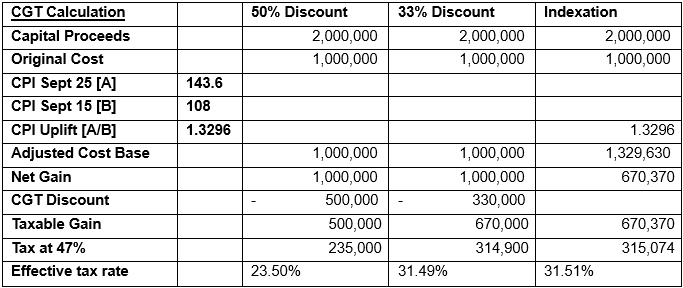
Exant Advisory delivers insightful CGT analysis, optimising client strategies with tailored, growth-focused financial solutions.

Clearly, the CGT discount provides a significant advantage to taxpayers, so it is perhaps it is understandable why the Government may wish to change it?

As a comparison of capital gains tax rates (for individual taxpayers) with other countries, we understand that the UK has a maximum rate of 24% for long term gains and the USA has a maximum rate of 28% for long term gains.

Our experts have the capabilities to assist you with your CGT requirements, please contact your usual Exant adviser or our expert Jamie Towers via the form below or on 07 3218 3900.

Ready to turn insight into action?
Connect with Exant Advisory.
We respect your privacy. Your information will be used only to share updates and insights from Exant Advisory, in line with our Privacy Policy. You can unsubscribe at any time.
All rights reserved. No part of this publication may be copied, shared, or utilised in any form without the explicit prior written consent of Exant Advisory, except for brief extracts used in media, social platforms, or other communications, provided Exant Advisory and where the original source is properly credited. Exant Advisory’s intellectual property remains protected at all times, and shall not be liable for any responsibility for third-party use of this publication, regardless of whether prior authorisation was granted. Please note, this document offers a general overview and should not be relied upon as a replacement for personal advice. The information contained herein was correct at the time of publication.
Led by Experience.
Driven by New Thinking.
Get in touch with Exant Advisory today and discover how our experienced specialists and innovative solutions can help you.
Subscribe to our newsletter
Experience. New Thinking.
Straight to Your Inbox.
Subscribe to the Exant Advisory newsletter for fresh perspectives, regulatory updates, and practical strategies shaping business success in Australia and beyond.
We respect your privacy. Your information will be used only to share updates and insights from Exant Advisory, in line with our Privacy Policy. You can unsubscribe at any time.